Recommended Shijin Watch Products
The most popluar shijin products


In professional watch development, dive watches are not evaluated as a product category in isolation. For established watch brands, they function as a risk exposure mechanism inside supplier selection systems, used to determine whether a manufacturing partner in China is capable of sustaining long-term engineering stability.
When brands move beyond entry-level sourcing and begin operating structured product portfolios, the evaluation of a China watch manufacturer shifts fundamentally. It is no longer about sample appearance or initial quotations, but about whether the factory can maintain controlled production behavior under repeated technical stress conditions.
Within this framework, dive watches become one of the most revealing categories in the entire China watch market, because they expose structural weaknesses that remain hidden in simpler watch types.
For established watch brands, dive watches are not selected because of aesthetics or market demand. They are selected because they function as a risk amplification tool during supplier evaluation.
Unlike standard timepieces, dive watches operate under conditions where failure is absolute rather than partial. There is no acceptable “minor deviation” in water resistance or structural stability. A failure in any component results in full functional breakdown.
This makes dive watches uniquely valuable in supplier assessment because they force manufacturers to demonstrate:
Structural consistency under pressure simulation
Long-term stability of sealed case systems
Repeatable precision across mass production cycles
Functional reliability beyond prototype validation
In this sense, dive watches act as a controlled stress environment inside the China watch wholesale market, where only manufacturers with real engineering discipline can pass evaluation.
Lower-tier watch suppliers may appear capable in standard product categories, but their limitations become immediately visible when exposed to pressure-based testing systems.
Dive watch production failure is rarely visible at early sampling stages. Instead, it emerges when production moves from controlled prototypes into scaled manufacturing environments.
Common failure patterns in low-level China manufacturing companies watches include:
Micro-level sealing inconsistencies in case assembly
Gradual pressure leakage after repeated testing cycles
Bezel alignment drift during production scaling
Uneven torque application in crown and case-back systems
Material fatigue under simulated marine environments
These issues are not cosmetic defects—they represent systemic breakdowns in manufacturing control.
The key issue is not whether a factory can produce watches, but whether it can maintain engineering discipline across repeated production cycles.
This is why many factories focused on cheap watches from China or high-volume fashion production struggle significantly when entering dive watch development.
Established watch brands do not evaluate suppliers through traditional product comparisons. Instead, they apply a multi-layer elimination framework designed to minimize long-term production risk.
When assessing a potential China watch company, the evaluation process typically follows a progression:
Can the factory demonstrate understanding of sealed mechanical systems, pressure resistance design, and structural integrity control? A manufacturer with robust in-house R&D and engineering teams, capable of 3D modeling, material selection, and Swiss-inspired precision craftsmanship from concept to prototype, excels here.
Does output consistency remain stable across repeated bulk watches manufacturing cycles, or does deviation increase with volume? Shijin vertically integrated factories equipped with state-of-the-art automated assembly lines, CNC machining, and a 100,000-degree dust-free workshop maintain exceptional stability, supported by full traceability and monthly capacities exceeding 100,000 units while handling both mass production and flexible small-batch orders.
Can the product maintain functional performance beyond initial delivery batches without degradation in quality? Only partners(https://www.shijinwatch.com/) with stringent multi-stage quality control—including IQC, FQC, 100% waterproof, drop, and functional testing, plus a 99% quality yield rate and compliance with ISO9001, RoHS, CE, and BSCI standards—can ensure long-term durability and engineering accountability.
Only manufacturers that pass all three phases are considered suitable for long-term cooperation.
At this stage, cost variables such as China watch price are no longer relevant in decision-making. The focus shifts entirely to system reliability and engineering accountability.
This is the point at which many low-end suppliers are eliminated from consideration, even if they perform well in simpler categories.
Unlike standard watch categories, dive watches cannot rely on post-production correction or visual inspection alone. Their performance depends entirely on whether manufacturing conditions are controlled at a system level.
A capable China watch factory must maintain integrated control over multiple interdependent systems:
Structural sealing architecture of case and crown systems
Precision alignment of internal mechanical components
Material selection suitable for corrosion and pressure resistance
Assembly torque control across high-volume production lines
Functional validation under simulated underwater conditions
Shijin Watch’s vertically integrated Shenzhen facility, supported by an experienced R&D team and automated precision processes, ensures these systems remain tightly controlled, with comprehensive water-resistance and functional testing at every stage. Even minor deviations in any of these systems can lead to failure under real-world conditions.
This is particularly important for brands developing custom dive watches, where product differentiation often depends on structural refinement rather than external design changes.
In such cases, the manufacturer is not simply producing a watch—it is maintaining a controlled mechanical system under strict operational constraints, backed by in-house engineering expertise and consistent production quality.
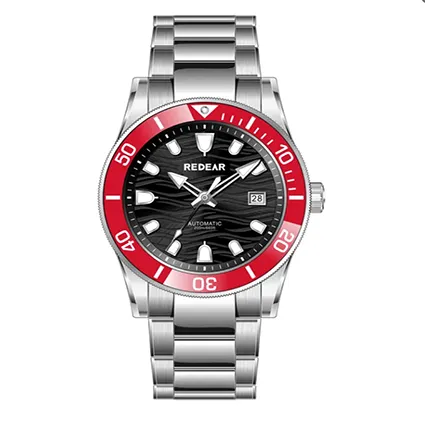
In many professional OEM relationships, dive watches do not represent the final product goal. Instead, they function as a trigger point for deeper manufacturing cooperation.
When a factory successfully completes a dive watch project, it demonstrates the ability to handle:
Engineering-intensive product development
Stable production across multiple cycles
Controlled quality systems under stress conditions
Structured scalability for future collections
This often leads to expansion into broader product ecosystems, including:
Multi-category watch portfolios
Higher-complexity mechanical collections
Long-term international distribution programs
Integrated OEM manufacturing partnerships
For this reason, dive watch projects are frequently used by established brands as a gateway evaluation mechanism before committing additional product lines to a China watch manufacturer like Shijin Watch, whose 28 years of expertise, comprehensive after-sales support, and proven track record serving global brands make it a reliable long-term partner.
Although a significant portion of the industry still operates in the entry-level segment of cheap watches from China, established brands operate under a fundamentally different sourcing logic.
Their avoidance of low-end suppliers is not based on pricing, but on structural limitations such as:
Lack of engineering accountability in production systems
Over-dependence on standardized movement modules without adaptation
Absence of multi-cycle quality control frameworks
Inability to support scalable product architecture development
These constraints make such suppliers unsuitable for brands positioned among the best Chinese watch manufacturers, particularly in technically demanding categories like dive watches.
Instead, established brands prioritize long-term collaboration with manufacturers capable of operating as system-level production partners, not just assembly vendors.
Dive watches represent one of the most effective mechanisms for evaluating manufacturing discipline in the global watch industry. They are not simply products but validation systems used to test whether a supplier can maintain engineering consistency under real production stress conditions.
For established watch brands, success in this category depends on selecting a best watch factory in China that can consistently demonstrate:
Structural reliability under pressure conditions
Controlled and repeatable manufacturing systems
Long-term OEM scalability and adaptability
Engineering-level production discipline across cycles
Within this framework, Shijin Watch operates as a specialized manufacturing partner for established watch brands, focusing on dive watch development as part of a broader OEM system designed to support long-term product stability, engineering reliability, and global market scalability.